In sports, particularly in football, film rules all. It helps players fix minute details, learn from what worked and rectify what didn’t. Great players can be film fiends, and the benefits far outweigh the drawbacks.
So how does that apply to construction safety technology? In a pretty useful way, according to Suffolk Construction.
Boston-based Suffolk entered a partnership with Arrowsight, a New York City-based company that combs footage of the jobsite from throughout the day and searches for examples of both good and bad safety behaviors, according to a March 17 news release.
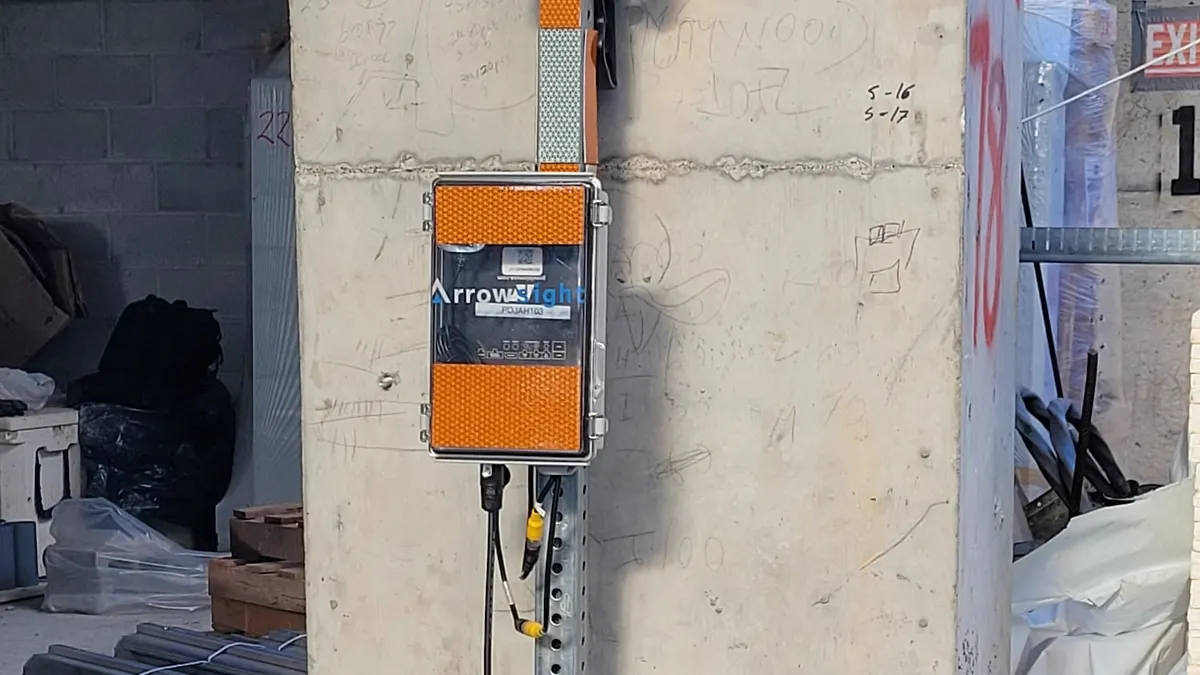
New York City-based Arrowsight uses fixed-point cameras and human-led video review to flag both risky and exemplary safety actions each day on jobsites, according to the announcement. Arrowsight designed its camera systems to be moveable, battery-powered and cell-enabled and can operate without electricity or internet.
To make the system work, Arrowsight’s cameras are set up across the jobsite and continuously monitor fixed points to capture hours of footage throughout the day. At the end of each day, the footage is sent over to Arrowsight’s auditing team.
Although Arrowsight uses artificial intelligence to analyze video in other fields, such as manufacturing, it uses its OSHA-trained human experts in construction, since jobsite environments are often unique. The process has allowed Suffolk's corporate and project safety teams to coach up laborers on the jobsite and highlight the good work that employees demonstrate.
The partnership follows a multi-year pilot of the technology helmed by insurance and risk management firms Zurich North America and Zurich Resilience Solutions. Throughout that pilot, Suffolk reported four times fewer claims and 10 times lower incurred losses on its projects, said Doug Ware, senior vice president of risk management for the builder, in the release.
Getting buy-in
Ware told Construction Dive in an interview that the difference between adopting a technology like Arrowsight’s versus another tech that required input from the craft labor force was the absence of administrative tasks.
“We're not going to them and saying, ‘Hey, you have to log into this iPad, or you have to use this portal and do this and enter your hours or your daily reports,’ or anything like that,” Ware said.
Where the company did find hesitancy, however, it stemmed from a Big Brother-esque sense of surveillance, Ware said, and a fear that it would impact workers’ productivity with constant interruptions to correct safety violations.
To combat this, Ware emphasized that this was a coaching tool, not a surveillance tool.
“We're reviewing this so we all get better, and how do we utilize this to ensure our individuals that are working on the job site aren't exposed to hazards?” Ware said.
As a matter of qualification, Arrowsight’s auditors were trained in Suffolk’s safety manuals and procedures, Ware said.
Contractor and tech collaboration
The training and knowledge are not set in stone. At times, Suffolk will inform Arrowsight that something the firm flagged is fine by the contractor’s safety standards. Alternatively, Arrowsight can find something that Suffolk then determines should be addressed with changes to its internal policies.
“Again, it really helps with the dialogue piece to help everybody get better, to identify potential existing hazards that are out,” Ware said.
That human-centric auditing process is an interesting wrinkle for the firm amid the rise of AI. Adam Aronson, Arrowsight’s CEO, told Construction Dive via email that while it uses AI in other fields, it doesn’t in construction. It also takes extra care before sending footage out to clients.
“Regarding AI, we do use AI extensively in manufacturing where there is full time dedicated power and extremely consistent work activities, but we do not use any AI in construction and rather audit 100% of the smart sampled high hazard work activities with OSHA trained civil engineers; furthermore, any flagged coaching videos are reviewed by at least one more senior manager prior to being sent to the clients,” Aronson said .
Ware said that the footage reaches his team as early as 4 a.m. For serious problems, Ware said that leaders will reach out directly to affected parties to address issues on a case-by-case basis. The company will also praise good behavior publicly.
At the end of the day, Ware said the benefits didn’t stop at saving money.
“The big piece that we look at this is, it's a tool to mitigate those exposures or reduce those injuries,” Ware said. “Yes, the money is good, but it's much more about changing those behaviors, making sure people are going home at the end of the day safe.”