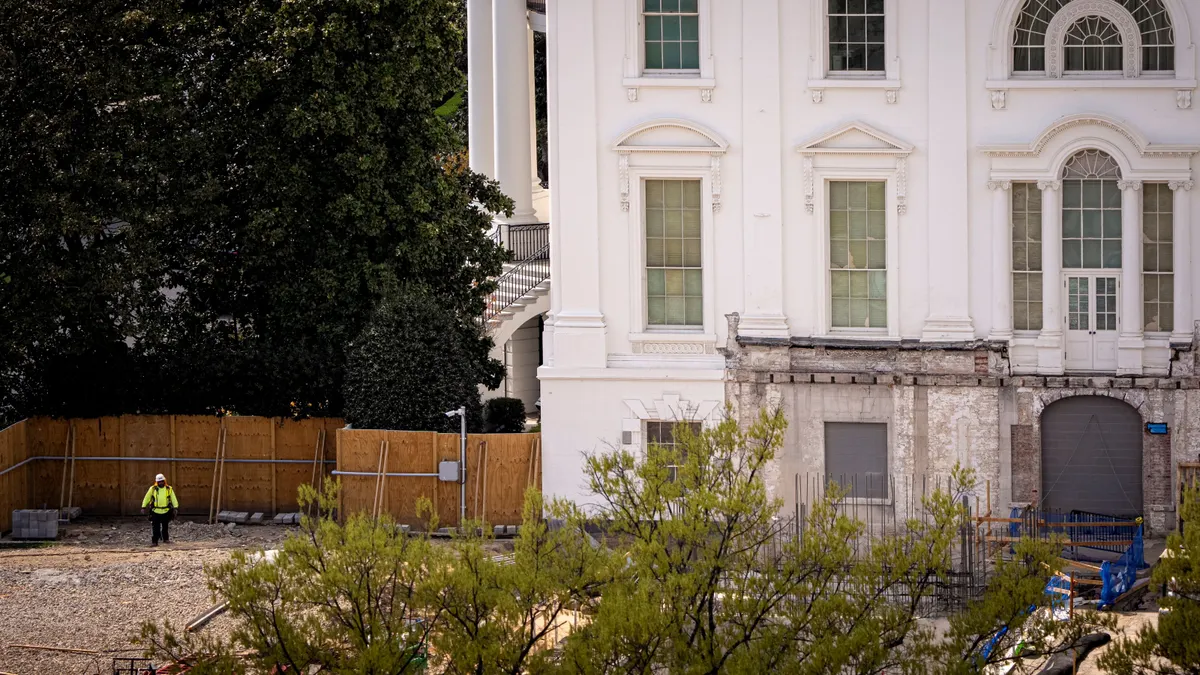
UPDATE: April 16 2026: The judge who halted the construction of President Donald Trump’s White House ballroom has amended his order to specify the type of work that must stop.
In response to the work stoppage order, the U.S. Court of Appeals for the District of Columbia Circuit urged U.S. District Senior Judge Richard Leon to review the national security ramifications of halting work. In addition to the ballroom, the White House argued work below ground included national security upgrades.
In response, Leon clarified his preliminary injunction “to specify that below ground construction may proceed, including the construction of any ‘top-secret excavations, bunkers, bomb-shelters, protective partitioning, military installations, and hospital and medical facilities,’ as well as such above-ground construction strictly necessary to cover, secure, and protect such facilities.”
He added a caveat that below ground work could continue as long as that construction does not “lock in the above-ground size and scale of the ballroom.”
Leon amended his ruling to only pause above-ground work for the planned ballroom. His order also said “national security is not a blank check to proceed with otherwise unlawful activity.”
The original story as reported continues below.
A federal appeals court has allowed construction on President Donald Trump’s White House ballroom to continue, for now.
In a 2-1 decision on April 11, judges from the U.S. Court of Appeals for the District of Columbia Circuit permitted work on the ballroom project to continue until at least Friday. The court has sent the case back down to a U.S. District Senior Judge Richard Leon, who ordered the work stoppage on March 31.
Leon’s ruling claimed that it was not within the president’s powers to alter the White House with major construction projects without approval of Congress. The original deadline for work to halt was 14 days, or this week.
The federal government’s appeal hinges on the argument that work must continue for safety and security. That includes ensuring the jobsite is secure. But the appeal also claims the project includes “national security upgrades,” in below-ground work.
In response, the appeals court instructed Leon to “promptly address the pending motion to clarify how the injunction and its exception will ensure safety and security” on the White House project.
In their decision, Judges Patricia Millett and Bradley Garcia — appointed by former Presidents Barack Obama and Joe Biden, respectively — urged for more clarity on what aspects of the ballroom are related to national security and safety, and therefore need to see work resumed.
“As a result, it remains unclear whether and to what extent the development of certain aspects of the proposed ballroom is necessary to ensure the safety and security of those below-ground national security upgrades or otherwise to ensure the safety of the White House and its occupants while the appeal proceeds,” the decision said.
In her dissent, Judge Neomi Rao, a Trump appointee, indicated the security vulnerabilities “prolonged by halting construction” meant that the federal government should be awarded the stay and that work should be able to continue.