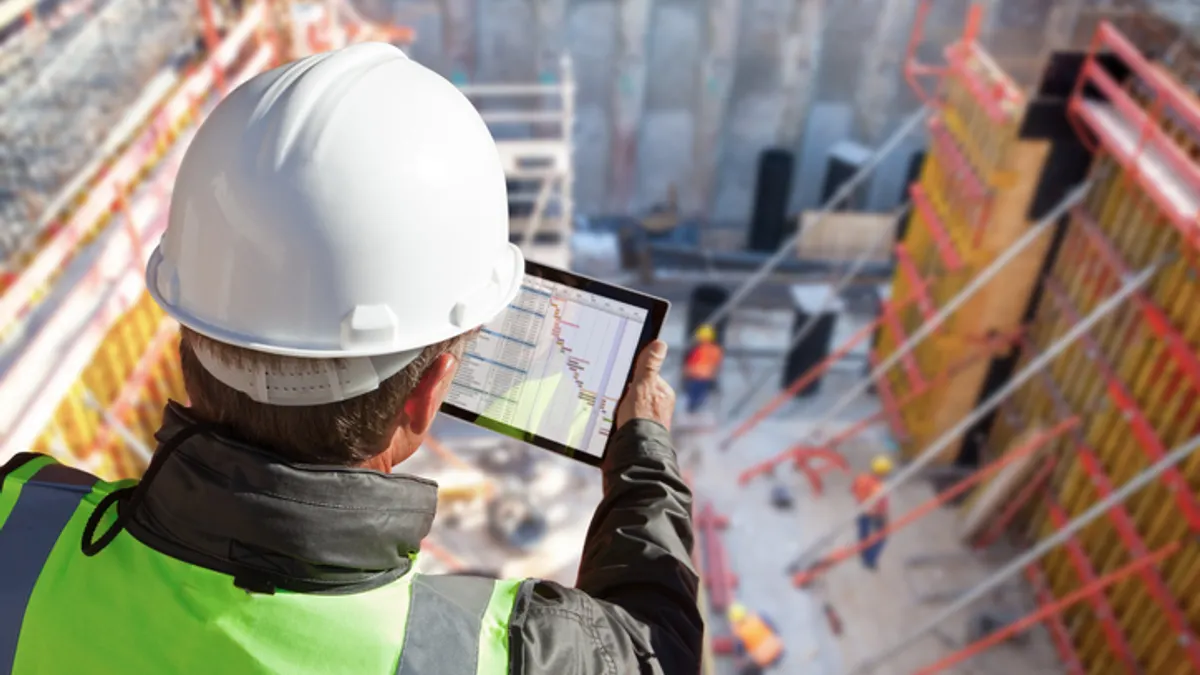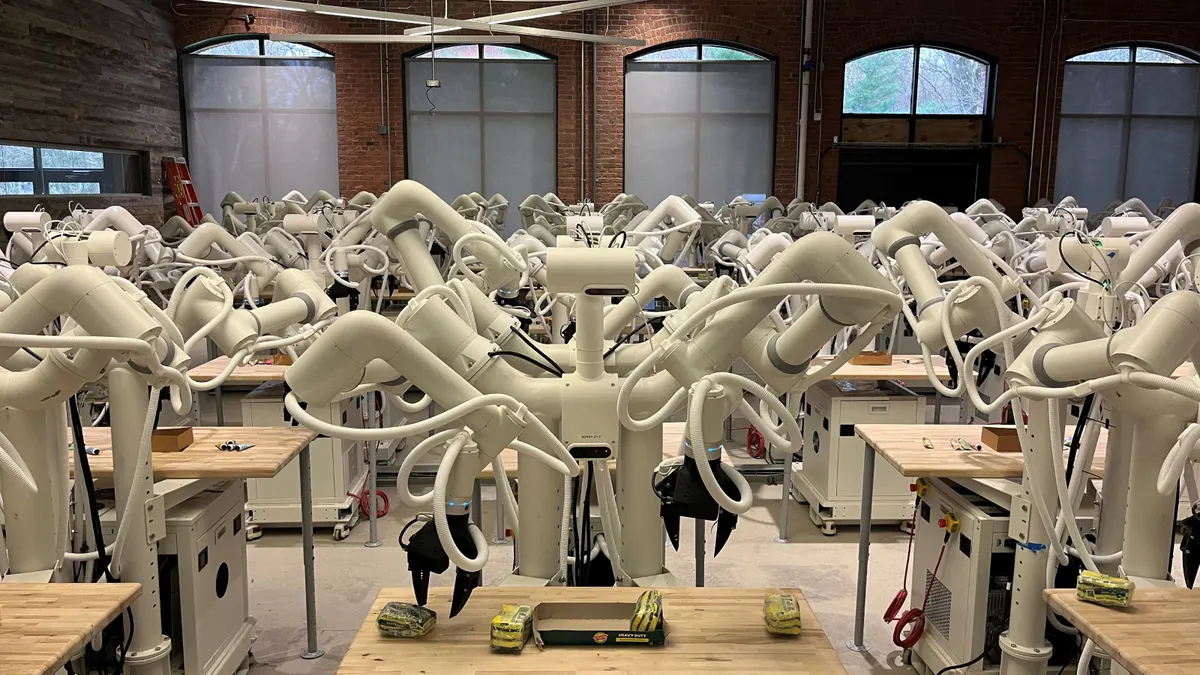
NEW YORK CITY — Robots are taking on real work on construction jobsites.
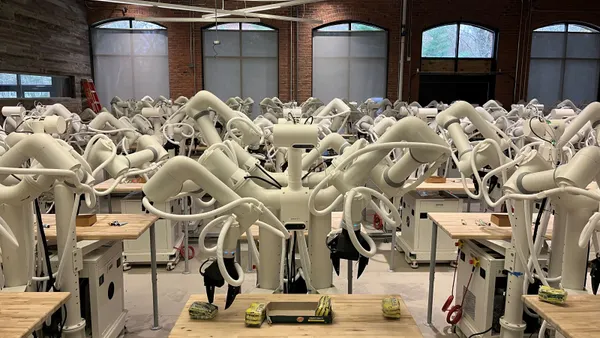
Automated machines can now handle tasks such as wall layouts or as-built installation scans. Contractors can then feed that data back into digital models. Artificial intelligence, meanwhile, analyzes drawings to update progress and flags conflicts in project schedules.
Combined, the technologies allow contractors to surface risk before it holds up work. More importantly, the tools also promise faster decisions and more predictable execution.
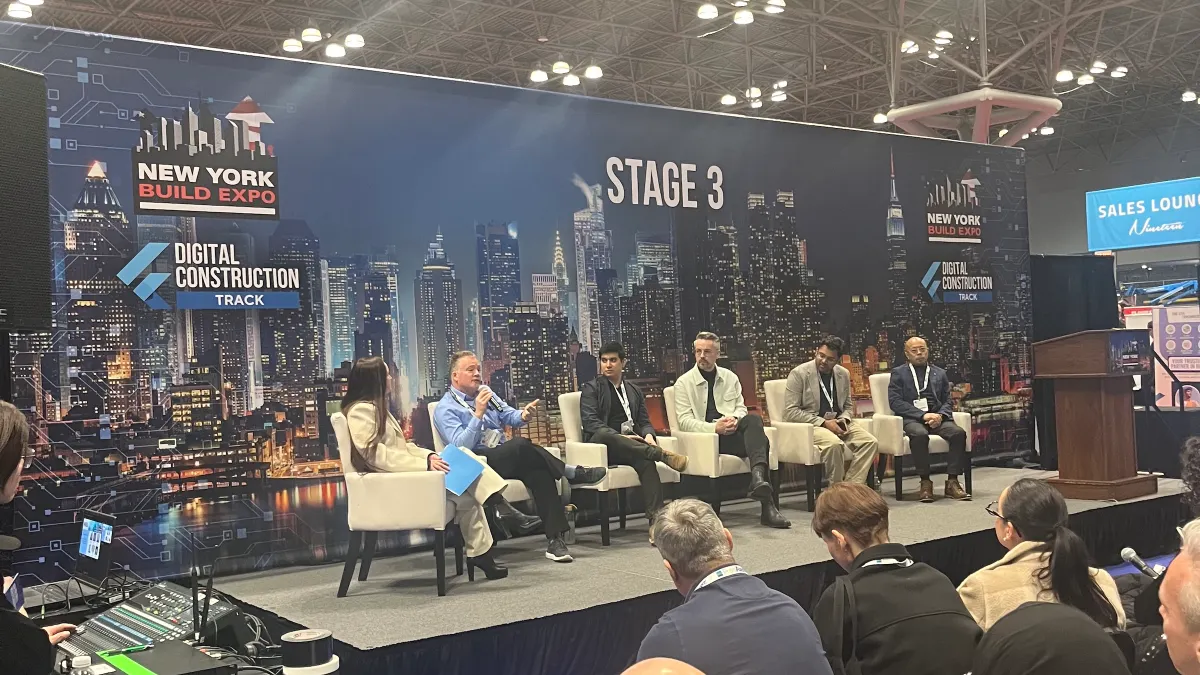
But during New York Build 2026, held in New York City March 18-19, executives said these tools must be fed the right data and inserted into a process where it makes sense with teams’ existing workflows.
“It becomes very clear what things need more input and oversight and what things you can start to delegate to these systems,” Eric Hull, senior project architect at Mancini Duffy, a New York City-based full service design firm, said during a panel session to discuss the role of AI in construction. “Even over the last year, especially over the last few years, the amount that you can trust in the accuracy of these systems has grown exponentially.”
On the planning side, firms are using AI to accelerate tasks that once required hours of manual review.
At New York City-based Turner Construction, for instance, teams have begun to build custom tools on top of large language models to analyze schedules and identify gaps in real time. In one case, a senior vice president created a software solution in days to evaluate project performance, using Anthropic’s Claude AI tool to surface logic issues and visualize conflicts across trades, said Ben Ferrer, Turner’s AI innovation manager.
“He just went straight to Claude, specifically Claude Code and Claude Cowork, and just said, ‘Here’s my schedule, here’s what my problem is,’” said Ferrer. “He built a full solution in a couple days, just on his own.”
Human role in AI integration
The shift is opening a new opportunity for how professionals can interact with project data. In other words, robots and AI tools are creating more of a role for human oversight, especially for experienced veterans in the industry.
“It’s not just the AI, it’s the orchestrator, the person who knows this capability, knows how to manage this capability,” said Ferrer. “That’s really where our mindset is starting to shift. It’s the operator that makes the difference.”
Contractors are slowly seeing AI as a way to move faster, said Shiva Dhawan, CEO and cofounder of Attentive.ai, the company behind AI estimating software Beam AI. These tools, for instance, can speed up a construction takeoff, the process of measuring and listing all material quantities and labor requirements on a given job.
“I think AI is here to take away the menial and manual, time-consuming part of your job,” said Dhawan. “It gives you back time so that you can build on more jobs.”
Importance of quality information
Despite these wins, firms are seeing a familiar constraint pop up for these applications. They say devices such as robot scanners and the AI models powering them are only as reliable as the information behind them.
“Garbage in, garbage out,” said Vincent Poon, VDC department manager at Structure Tone, a New York City-based general contractor. “If the information is good, you’re going to get a good output.”
Problems begin, however, when that information does not match up, which still happens frequently, panelists said.
In many cases, design models do not fully align with construction documents. Updates can also arrive in fragments through bulletins or revisions. The inconsistency creates risk when teams rely on automated systems to interpret or act on the data.
“We had a bad experience with a certain GC, didn’t check anything, and just took our model wholesale, all kinds of problems with layout,” said Anthony Hartke, VDC director at Turner. “So, having an understanding of what information we’re being provided, what we rely on, what we need to be keeping an eye out for. If we’re not communicating and we’re assuming, we're going to have problems.”
To solve this, firms have been experimenting with workflows that connect AI and robotics into one loop. For example, robots can first scan installed work and compare it against the digital model. AI then analyzes the upload for any discrepancies and directs crews to correct issues where necessary.
In theory, the approach would improve execution and ultimately how information moves through a project, said Poon. But it also has to align with how building actually gets done to be useful.
“At the end of the day, does it integrate with the existing process? Is it authentic? Does it add complication? Does it add time? Does it add effort?” said Poon. “Those are the things that we look at.”
Finding the right fit
The irony is that to fully reap the benefits of AI and robots, teams must coordinate better than ever before, panelists said. Without effective cooperation, the AI tools won’t magically boost productivity onsite, said Hartke.
“If you take an old broken process and jam it into a new tool, all you’ve got is a new shiny tool with an old broken process,” said Hartke. “So, to adopt robotics efficiently and effectively, you need to look at that process, potentially retool and rebuild it, to operate effectively.”
That coordination is most visible during the transition between the physical and digital worlds. Prefabrication and robotic layout rely on precise inputs. Construction in the real world, however, rarely offers perfect conditions.
“The digital world is perfect. The world’s not perfect, we’re messy,” said Bill Seery, director of prefabrication at Milford, Massachusetts-based Consigli Construction. “Have the prefabricators done this enough where they can show me real world examples? If they’re showing me all models and nothing of physical pictures, that starts to scare me, because that means they haven’t actually dealt with the real world before.”